|
Mrs Hargreaves Remembers |
|
a piece for soprano and instrumental ensemble
also available in a shortened version for soprano & piano
music by Martin Wesley-Smith |
|
first performed Friday July 11 1997 at the Alliance Francaise Society, Sydney, by Miriam Gordon (soprano) and members of The Spring Ensemble conducted by Luke Dollman
most recent performances:
|
| internal links: | |||
| program note | the script | footnotes | clippings |
external links:
|
Martin |
Wesley-Smith
Peter | Wesley-Smith
Lewis Carroll | home page
Boojum! |
home page |
|
program note |
|
|
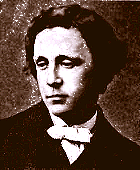
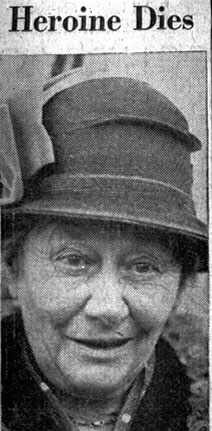
In 1932, 79-year-old Mrs Reginald Hargreaves travelled to America from her native England to receive an honorary doctorate from Columbia University in New York. It was the centenary of Lewis Carroll's birth, and Mrs Hargreaves, before marriage to crack county cricketer Reggie, had been Alice Liddell, the real-life inspiration for Lewis Carroll's best-known nonsense classics Alice's Adventures in Wonderland and Through the Looking-Glass - and What Alice Found There. The doctorate was in recognition of her role in the creation of those masterpieces of English literature. This piece depicts (quite fancifully) Mrs Hargreaves, the night before the degree is to be conferred, having a massage while rehearsing her acceptance speech. She soon wanders from what she had prepared and reminisces, with great fondness, about her childhood friend the Rev'rend Charles Lutwidge Dodgson (Lewis Carroll's real self). Her main focus is his depiction of himself as the White Knight in Through the Looking-Glass. |
|
the script |
|
| During a musical introduction, Mrs Hargreaves enters, wrapped in a towel fastened at the back, and lies face down on a massage table. A masseuse (a flautist, dressed in white) opens the towel at the back to reveal Mrs H's bare back, which she proceeds to massage. When Mrs H sings, the masseuse pummels her back so that the rhythms she plays are transmitted through the voice: |
|
Ah ... ah ... ah ... ah ... |
| Mrs H lifts her head and faces the audience |
|
It gives me great pleasure to be here today to accept this degree that you've bestowed upon me on this most auspicious occasion ... 1
Ah ... impenetrability ... 2
I remember Humpty there on the wall and the Unicorn, and the Bandersnatch,
and the dear old White Knight
|
| The masseuse fastens the towel; Mrs H sits on the table to sing the following song: |
|
He sang 3
"I'll tell you ev'rything I can There's little to relate I saw an aged aged man A-sitting on a gate 'Who are you, aged man?' I said 'And how is it you live?' The answer trickled through my head Like water through a sieve. He said 'I look for butterflies That sleep among the wheat: I make them into mutton pies, And sell them in the street. I sell them unto men,' he said, 'Who sail on stormy seas; And that's the way I get my bread - A trifle, if you please.'" |
| Trumpet solo; Mrs H walks downstage |
|
He would sing to me, this troubador He was quite extraordinary He would tell me cautionary Tales for me to dream about A genius there'd seem no doubt What would life have been without My Knight? 4 |
| Mrs H speaks, over music: |
| Of all the strange things that I saw in my journey Through The Looking-Glass, this is the one I've always remembered most clearly. I can bring the whole scene back again as if it were only yesterday. 5 |
| Mrs H sings: |
|
For more than sixty years 6 Less than a hundred He lived in hopes and fears And often wondered If he should ever find Gentle and pure love A Dulcinea God designed A sweet mature love It gives me great pleasure to accept this award It's an honour I appreciate But it belongs to that aged aged man A-sitting on a gate |
| Mrs H returns to the massage table; the masseuse unfastens the towel, and massages Mrs H's bare back, again. Mrs H sings, while being pummelled: |
|
Ah ... ah ... ah ... ah ... |
| Mrs H speaks, over music: |
|
I remember the mild blues eyes and the kindly smile of the knight, the setting sun gleaming through his hair and shining on his armour in a blaze of light ... and his horse quietly cropping the grass at my feet ... |
| Mrs H falls asleep on the massage table. |
| The instrumentalists chant as well as play: |
|
word, ford, food, fool, foul, soul, sour, dour, doub game, gale, pale, pane, pans, pens, lens, less, lets! 7 white knight, while, whine, shine, shins, chins, chink, clink, clank, clack, black [k]night!
Alice, slice, slick, slack, snack, snark! |
| Mrs H wakes up! She sings: |
| (c) 1997 | ||
| Martin Wesley-Smith | Peter Wesley-Smith | |
| e-mail: mwsmith@shoalhaven.net.au | e-mail: peterws@shoalhaven.net.au |
![]() |
footnotes |
|
| internal links: | |||
| program note | the script | footnotes | clippings |
| more external links: | ||
| Quito |
Sydney Conservatorium |
mw-s discography |

|
clippings |
|
| New York Times | Herald Tribune |
The white rabbit with the pink eyes, who "actually took a watch out of its waistcoat-pocket" peered over her shoulder and muttered once again: "Dear, dear! I shall be too late!"; the Cheshire Cat grinned monotonously at the miraculous steel disc, and the walrus discussed, as it always has, many things. And Lewis Carroll himself spoke into the microphone in words written long ago, when Alice read three Carroll letters and a rhyme, believed to have been hitherto unpublished.
Mrs. Reginald Liddell Hargreaves of Lyndhurst, England, who seventy years ago as a demure 10-year-old Alice was the inspiration for Lewis Carroll's whimsical creations, seemed almost as excited with her newest adventures in the wonderland of New York as she was in 1862 when [? - unclear] Dodgson, an Oxford Don, spun for her amusement his imperishable nonsense.
Probably because of her lifetime of association with the Mad Hatter, Father William and the sanguinary Queen, who insisted: "Off with their heads!" Mrs. Hargreaves has become quite accustomed to the elfish tricks one is likely to encounter in looking-glass land, but the express elevators in the tallest building in the world and the rumble of Fifth Avenue traffic can still give her a thrill despite her gray hair and her eighty years, lacking two days.
The pace of New York seemed to have tired her and her voice trembled somewhat with the fatigue and the excitement of it as she faced the little quivering disc that seventy years ago would have been as much of a miracle as a rabbit with a waistcoat pocket.
"Coming here," she said - after her son, Captain Caryl Hargreaves, formerly of the Scots Guards, had introduced her - "coming here is an adventure overseas instead of underground.
"America and New York City are such exciting places that to visit them takes me back to Wonderland."
Her voice wavered as it sped out over the WABC-Columbia network to thousands of eager ears.
"Express elevators don't give me much time to take things off the shelves, however," she added.
Her voice trembled again.
"If the children expect to see a girl like me - I mean a young girl such as I was, like the one in the books - I am afraid they will be disappointed. After all, if they had seen me in the boat in 1862, they would probably have thought my sisters and I were just like other children. Then, if they hesitated a minute, they might have noticed the kind-looking parson who was stroking the oar, and if they had stopped to listen to what he was saying, they might have looked at us again, wondering whether we were quite ordinary children going down rabbit holes and having tea with the Dormouse.
"I should like to take all the children who want me to go down the rabbit hole with me again," Alice continued, "but as I cannot do that, I am going to read you some letters which Lewis Carroll wrote me in later life. In these letters you will notice the great interest he took in helping children's hospitals and homes. And in this connection it is interesting to hear of the funds that are being collected both in New York and London for that purpose at the present time. In New York they propose to endow a memorial library to be attached to the Children's Hospital, and in London they hope to get enough money to build a children's ward onto the St. Mary's Hospital, Paddington.
I fancy this will come to you like a voice from the dead after so many years of silence. And yet those years have made no difference that I can perceive in my clearness of memories of the days when we did correspond. I am getting to feel what an old man's failing memory is after recent events with new friends.
For instance, I made friends only a few weeks ago with a very nice little maid of about 12 and had a walk with her, and now I can't remember either of her names. But my mental picture is as vivid as ever of one who was so many years my ideal child friend. I have had scores of child friends since your day, but they have been quite a different thing. However, I did not begin this letter to say all that. What I want to say is, what I want to ask you is, would you have any objection to the original manuscript book of Alice's Adventures, which I suppose you still possess, being published in facsimile? The idea occurred to me only the other day. If, on consideration, you come to the conclusion that you would rather not have it done, that will end the matter. If, however, you give me a favourable reply, I would be much obliged if you would lend it to me - registered post would, I think, be the safest - that I may consider the possibilities. I have not seen it for about twenty years, so I am not by any means sure that the illustrations may not prove to be so awfully bad that to reproduce them would be absurd. There can be no doubt that I shall incur a charge of gross egotism in publishing it, but I don't care for that in the least, knowing that I have no such motive. Only, I think, considering the extraordinary popularity that the books have had (we have sold more than 120,000 of the two), there must be many who would like to see the original form.
Always your friend,
C. L. DODGSON.
After a great deal of casting about among photographers and zincographers I seem at last to have found out the man who will reproduce "Alice's Adventures Underground" in really first rate style. He has brought his things to Oxford and I am having all the photographs taken in my own studio, so that no one touches the manuscript book except myself. By this method I hope to be able to return it to you in as good a condition as when you so kindly lent it to me. Whether the reproductions will be a source of pride or not it is impossible to say; but if it is, I hardly like the idea of taking all the profit, considering the book is now your property, and I was thinking of proposing to send half of them to you. But a better idea has now occurred to me which I now submit to you for your approval. It is to hand over the profits to hospitals and homes for sick children.
Very sincerely yours,
C. L. DODGSON.
"He writes to me again on Nov. 6, 1886:
Little maidens, when you look
Christmas - 1861
Two thousand persons rose to their feet as the now frail figure of the story's heroine appeared on the platform - Alice walking slowly with the aid of a cane and smiling shyly in response to the applause that swept the room.
"I beg to thank you," she said, "for your great kindness in inviting me to attend this celebration of the centenary of my childhood friend. He was the ideal friend of childhood."
Here her voice quivered and broke for an instant, but she rallied quickly and continued: "I often wonder how many wonderful stories may have been lost to the world, because he never wrote anything down until I teased him into doing it. I believe, however, the best of his stories are all embodied in the two books, for when I read them I remembered many old stories and found them there again, that he used to tell us in the boat or sitting on the bank of the river. Least of all persons he did not dream - that very retired parson - (I can even remember a curious stutter in his speech) - that because of those stories he used to tell us I would be coming here in 1932 to celebrate the centenary of his birth.
"I am very pleased to be here, and to thank you for your very kind reception to the book and to me. I thank you again and again."
All these wonderland creatures were explained later in the chief address of the afternoon, delivered by Professor Harry Morgan Ayres, of the university's English department, who analyzed Alice's adventures as an allegory of every child's progress to maturity, beset by hostile and incomprehensible personages.
"Alice herself," he said, "had a quality which I do not notice much in children nowadays - an overwhelming desire to please - it is the keynote of her character."
Mrs. Hargreaves joined in the laughter which followed this sally.
"Poor little Alice was ill prepared to cope with this world. Every word she uttered seemed to give offense. She was betrayed on all sides.
"It was not until she learned to speak up for herself, that she entered the alluring garden of further adventures. Humpty-Dumpty taught her a further lesson, namely, to become lord of words and their meanings, not their slave."
Professor Ayres paid tribute to Mrs. Hargreaves as "one of the great heroines of literature, who if she had not always been as wise as her great and kindly teacher strove to make her, at least has the consolation of knowing that the painful travels of her immortal quest have been the cause of much wisdom in others and of that kind of mirth that is wisdom's fairest offering."
Mrs. Hargreaves was introduced by Dr. Nicholas Murray Butler, president of the university.
The glee clubs of Barnard and Hunter Colleges sand selections from the suite "Alice in Wonderland," assisted by the Columbia University orchestra.
Mrs. Hargreaves was wearing a gown of brown lace and a brimmed hat of brown straw, edged with pale yellow.
The tonic of the New York climate has benefitted her, it was said, and now that the strain of the public ceremony has ended, her hosts anticipate that she will want to see the sights of the city.
Reads Carroll's Letters.
My dear Mrs. Hargreaves:
Letter on Returning Book.
My dear Mrs. Hargreaves:
Would you mind extending the profits, if any, of Alice Underground to hospitals for children? You suggested homes only, but surely hospitals need help quite as much.
Verse written in a copy of "Holiday House," a Christmas gift from C. L. Dodgson to L., A. and E. Liddell:
On this little story book,
Reading with attentive eye
Its enticing history,
Never think that hours of play
Are your only holiday.
And that in a house of joy
Lessons serve but to annoy:
If in any house you find
Children of a gentle mind
Each the other pleasing ever -
Each the other vexing never -
Daily work and pastime daily
In their order taking gayly -
Then he very sure that they
Have a life of holiday.
New York Times
Herald Tribune
On her eightieth birthday Mrs. Alice Liddell Hargreaves, the original Alice of "Alice in Wonderland," was the guest of honor yesterday at Columbia University at special exercises celebrating both her own anniversary and the centenary of Lewis Carroll, author of the famous story.
Pays Homage to Carroll
Is Given Second Ovation
Says Carroll Was White Knight
Relatives Share Honors
New York Times
Herald Tribune
My thanks to Joel Birenbaum and the
Lewis Carroll
home page
!!
program note
the script
footnotes
clippings
Martin
Wesley-Smith
Peter
Wesley-Smith
mw-s
discography
Quito
[click photos for larger versions]
Alice Liddell, photographed by
the Rev'rend Charles Lutwidge Dodgson
Alice Hargreaves,
not long before her death
mw-s works: |
Quito |
Boojum! |
Cock Robin |
X |
Manners for Men
mw-s discography
|
articles, letters etc (re East Timor, Conservatorium etc)